
Without a doubt, the primary reason for the Cardinals’ positive 20-14 start can be credited to their offense.
As much as I’ve talked about the effectiveness of their small-ball skills, that’s a secondary asset. So let’s try to avoid turning the small-ball meme into a full-fledged, forced tribute to the 1980s style “Whiteyball.” As much as this style has helped the cause, there's no reason to exaggerate the impact.
I’ve been doing some of that, so I’m not taking swipes at anyone else. And I do respect the way an opportunistic St. Louis side navigates the bases, moves teammates over with productive outs, stays alert and remains committed to doing the so-called “little things.” These small but beneficial situational touches have helped the Cardinals win some close games.
That said, the biggest difference between the 2025 Cardinals and the 2026 offense is the increase in power.
And the reasons behind the power charge? Nothing random about it. It isn’t a fluke. It isn’t early-season noise.
Here's the exciting part about this: We’re seeing the early results of the new foundational approach implemented by the offense and the impressive way many St. Louis hitters have adapted and executed their strategy at the plate.
In short, we’re seeing evidence of the updated, modernized and intelligent makeover of the front-office operation under the leadership of president of baseball ops Chaim Bloom and his cabinet.
The Cardinals are using better analytics, technology, advanced instruction and hit tools to power up. That combination of factors has led to more barrels, greatly enhanced launch angles, a harder contact rate, the lowering of the ground-ball rate, and less chasing of pitches out of the strike zone. There’s been more control of the strike zone, fewer wasted at-bats – and a lot more bang, boom and blasting on contact.
Last season the 2025 Cardinals finished 29th in the majors in home runs per game, and generated a flat and non-threatening .379 slugging percentage that ranked 27th overall. The offense shriveled to a rate of 4.25 runs per game, finishing 14th among the 15 National League teams.
This season? Through 34 games, the Cardinals are tied for fourth in the majors with an average of 1.29 home runs per game. If the Redbirds can maintain that pace, it will carry them to the most homers in a season by a Cardinals team since 2016.
The 2025 Cardinals clubbed a home run every 36.7 at-bats. In 2026, the AB/HR ratio is a more loaded 25.9. Big change. And the slugging percentage has gone north in the rankings this season, currently ninth overall at .403.
The run-scoring pace reflects the new energy and potency. As the Cards enter a new week of play, they’re 9th in the majors at 4.88 runs per game.
Jordan Walker leads the Cardinals with 10 home runs, but he’s hardly alone. Going into Monday the Cards were the only team in the majors that had five different guys standing with five or more home runs this season: Walker 10, JJ Wetherholt 7, Alec Burleson 5, Nolan Gorman 5, Nathan Church 5. And Ivan Herrera (4) and Pedro Pages (3) are trying to club their way onto the list.
The impact of this robust power game is covering for the unreliable St. Louis bullpen. Despite significant chaos during the late innings, the Cardinals through Sunday were 16-1 this season when leading a game through six innings.
Why? Because the STL offense leads the majors with 16 homers – and is fifth in runs scored – from the start of the seventh inning until the end of the game. And half of the Cards’ 44 total home runs have been deposited after the start of the 6th inning.
Basically it’s worked like this: the Cardinal offense prevents late leads from slipping away by beating up on the other team’s bullpen more than the other opponent punishes the St. Louis relievers.
I cringe to think about what the Cards’ record would be without the offense repeatedly arriving on the scene to pull off another rescue. Is there a way to give the Cardinal hitters credit for the saves?
There are several factors we can focus on to explain the abundance of power:
1. Jordan Walker. Are you kidding? During the 2024-2025 seasons (combined) Walker had 11 home runs in 527 at-bats. That’s one bomb every 47.9 ABs. That’s, um, bad. This season: 10 home runs in 127 at-bats. That’s a homer every 12.7 ABs. That’s phenomenal.
More on Walker in a bit; I have a wonderful chart to show you that specifies the exact reasons why he’s having a career-best season. As a warm-up, let me share this: Walker has shown dramatic improvement in quality of contact, lowering his chase rate, hitting the ball with mighty strength and authority, and a new mastery of launch angles that keep him from squandering his hard-hit bullets on too many ground balls. Pardon my hyperbole, but one word for these changes by Walker: revolutionary.
2. JJ Wetherholt. The rookie didn’t waste a moment in becoming the driver of this offense. With seven home runs through Sunday, JJ had more bombs early this season than Shohei Ohtani, Bryce Harper, Pete Alonso, Manny Machado, Jose Ramirez and Corey Seager. Wetherholt’s .438 slugging percentage put him ahead of Vladimir Guerrero Jr., Freddie Freeman, Carlos Correa, William Contreras and Randy Arozarena. Compared to 2025, Wetherholt has upgraded the team’s performance at two different places on offense: at the leadoff spot, and at second base.
3. The 1-2-3-4 spots in the STL lineup are primarily filled by Wetherholt, Ivan Herrera, Alec Burleson and Jordan Walker. That foursome at the top four spots is collectively producing a set of numbers that puts St. Louis right up there with the Braves, Yankees, and Astros in performance from the 1-2-3-4 hitters. Compared to the first four lineup spots fielded by the other 29 teams, Redbird hitters rank fourth in wRC+ (30% above league average), fourth in on-base percentage (.363), sixth in slugging (.449) and fourth in OPS (.813.) . The STL first four are ninth in doubles (29) and ninth in homers (24.)
There are other reasons, sure. But let’s jump ahead to our findings and a comparison of 2025 and 2026. The “before” and “after” look is stunning:
Take a look at this chart and the “before” and “after” picture of the offense from 2025 to 2026:
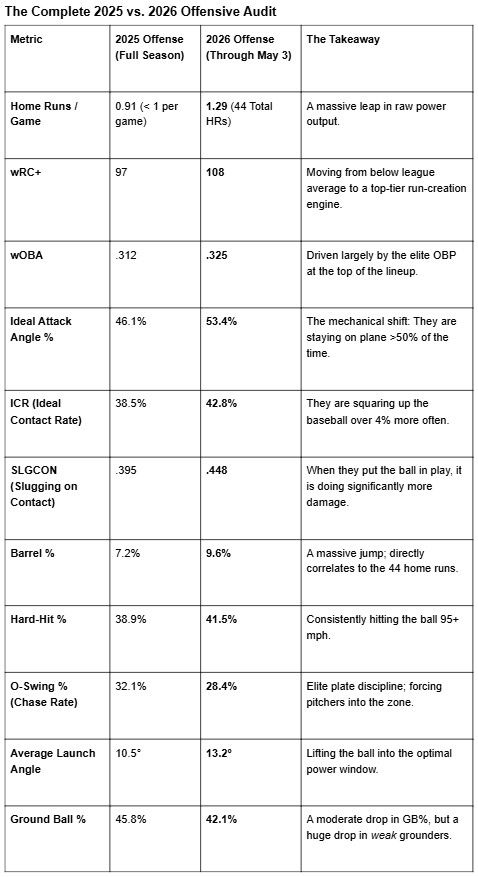
Comments on the chart: The Ideal Contract rate (ICR) is huge. Last season, the Cardinals were bogged down by topped ground balls and weak flares. This season the higher ICR means more barrels, solid contact, and productive flares and burners. They aren’t relying on bloods; they are smacking the baseball now – as evidenced by the SLGCON metric.
The ground-ball rate for ‘26 may seem high but it’s misleading – and offset by the impressive launch angle and barrel percentage. The Cardinals haven't turned into an extreme fly-ball team that leads to too many easy outs. They’ve raised their average launch angle just enough (from 10.5° to 13.2°) to catch the ball out front. By doing this, the balls that are elevated are being barreled up at an elite percentage. Jordan Walker's mechanical fixes to stop “chopping” the ball is the most visible example of this team-wide change.
Finally, the wOBA and wRC+ reflect a positive sharpening of the Cards’ plate discipline. By shrinking the zone and cutting down on the chase, the Cardinals have inflated their wOBA, gotten into better hitter's counts, and are pushing opposing pitchers to go with more fastballs over the plate.
Again: this was, and is, part of the plan. The modernized strategy. The new, refined approach. The targeting of specific characteristics that make the St. Louis hitters more dangerous – instead of remaining dormant.
Now … presenting the “new” version of Mr. Jordan Walker. Note: depending on when you read this, some of the numbers here may have changed a bit. But either way, the numbers tell an accurate and encouraging story on Jordan Walker.
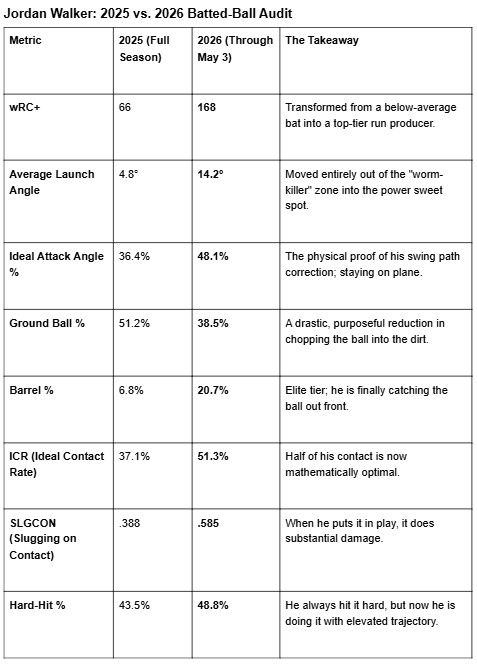
What this means: Going from a 36.4% Ideal Attack Angle to 48.1% means he eliminated the steep, downward "hook" in his swing. By keeping his barrel in the zone longer on an upward plane, he gives himself a huge margin of error. Even if he is slightly early or tardy on a pitch, the smoother bat path ensures he still has a shot to shoot into the gaps.
Walker has always had upper-percentile raw strength, but a hard-hit percentage without lift is junk. It is empty calories.
The 2026 data shows what happens when you combine that raw exit velocity with the proper launch angle. Roll out the barrels! And we can pretty much draw a straight line from the enhanced launch angle to his .585 SLGCON. Walker re-engineered his swing, and the results are pretty remarkable.
Thanks for reading … and please pardon my typos …
–Bernie
Bernie was inducted into the Missouri Sports Hall of Fame in 2023. During a St. Louis sports-media career that goes back to 1985, he’s won multiple national awards for column writing and sports-talk hosting – and was the lead sports columnist at the Post-Dispatch from 1989 through 2015. Before that Bernie spent a year at the Dallas Morning News, covering the Dallas Cowboys during Tom Landry’s final season (1988) plus the sale of the team to Jerry Jones and the hiring of Jimmy Johnson as coach. Bernie has covered several Baseball Hall of Fame managers during his media career including Tony La Russa, Whitey Herzog, Earl Weaver, Joe Torre and (as an interim) Red Schoendienst. In his career as a beatwriter and columnist, Bernie covered Pro Football Hall of Fame coaches Joe Gibbs, Tom Landry, Jimmy Johnson and Dick Vermeil on a daily basis.
Bernie has covered and written about many great St. Louis sports team athletes including Albert Pujols, Kurt Warner, Brett Hull, Yadier Molina, Adam Wainwright, Jim Edmonds, Marshall Faulk, Scott Rolen, Mark McGwire, Orlando Pace, Isaac Bruce, Torry Holt, Adam Wainwright, Chris Carpenter, Al MacInnis, Brian Sutter, Bernie Federko, Chris Pronger, Dan Dierdorf, Jackie Smith and Aeneas Williams. Bernie covered every baseball Cardinals’ postseason game from 1996 through 2014 and was there to chronicle teams that won four NL pennants and two World Series. He provided extensive coverage on the “Greatest Show” St. Louis Rams and has written extensively on the St. Louis Blues, Saint Louis U, and Mizzou football and basketball. Bernie was/is a longtime voter for the Baseball Hall of Fame, Pro Football Hall of Fame, Heisman Trophy and the St. Louis Cardinals Hall of Fame.
You can access his columns, videos and the podcast version of the videos here on STL Sports Central, catch him regularly on KMOX (AM or FM) as part of the Gashouse Gang, Sports Rush Hour, Sports Open Line or Sports On a Sunday Morning shows. And you can catch weekly “reunion” segments here at STL Sports Central featuring Bernie and his longtime friend Randy Karraker.